CASE STUDY ON THE CONDUCT OF TRAINING AND COMPETENCY ASSESSMENT FOR PERSONS WITH DISABILITIES IN BARISTA NC II AND HOUSEKEEPING NC II
Persons with disabilities in the Philippines is estimated to be about 1,443,000 persons or 1.57% of the total household population in the Philippines. The statistics show that there are more male (50.9%) than female (49.1%) PWDs. They are described as those whose have long-term physical, mental, intellectual or sensory impairments which in interaction with various barriers may hinder their full and effective participation in society on an equal basis with others. They are considered to be one of the most marginalized and economically disadvantaged groups not only in the country but worldwide especially in developing countries.
Inclusion of all in development is the common theme of the United Nation’s Sustainable Development Goals (SDGs) 2015 - 2030, the sequel of the Millennium Development Goals (MDGs) 2000 - 2015. The Philippine government is not far behind in ensuring the marginalized sector including Persons with Disabilities (PWDs) to be covered in all government services. While the United Nations unanimously adopted the Convention on the Rights of Persons with Disabilities (CRPD) on 13th December 2006, which entered into force on 3rd May 2008, the Philippines as early as 1992 had already passed its Magna Carta for Persons with Disabilities, the law which provides guidelines on the treatment and mainstreaming of PWDs in Philippine society.
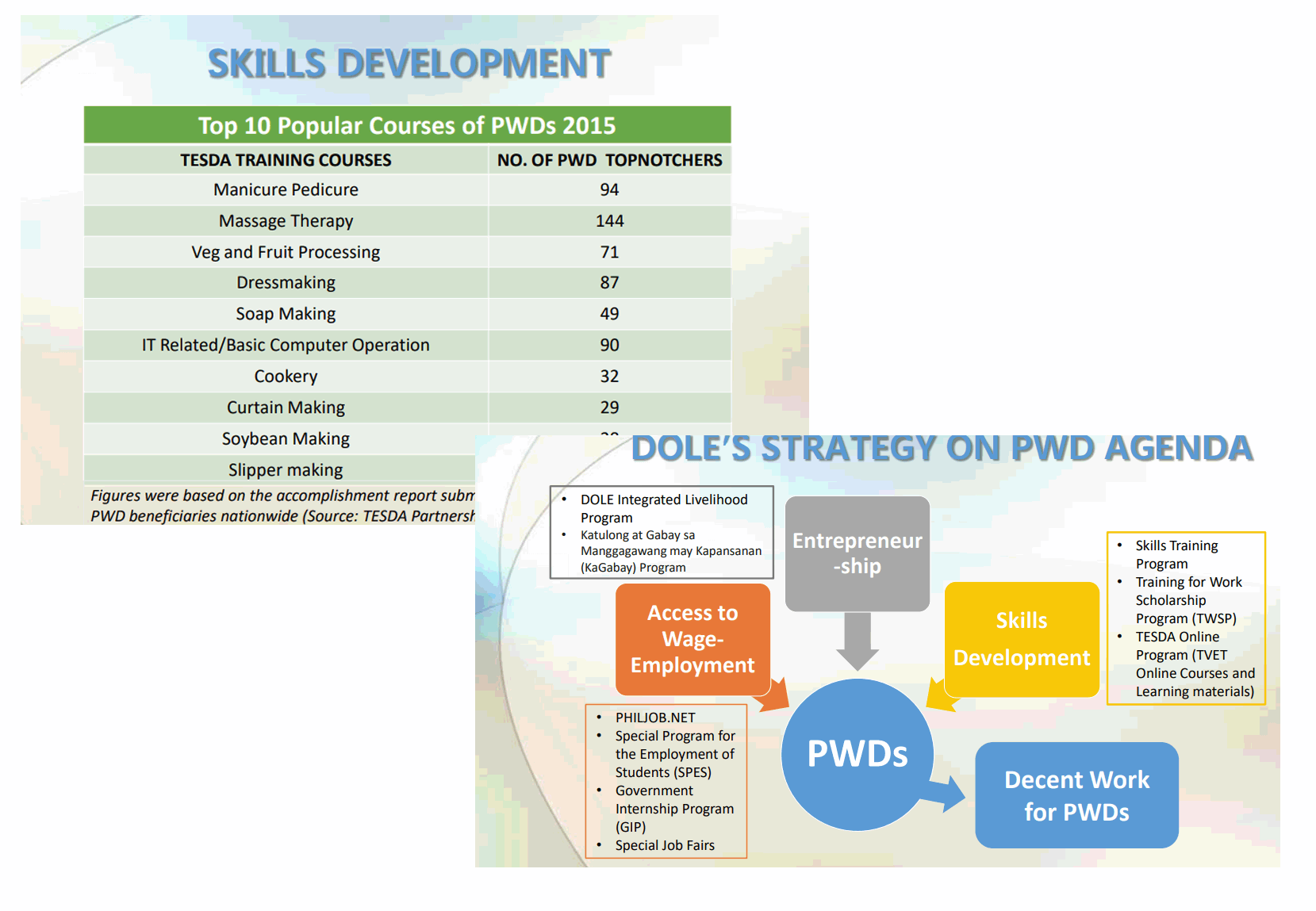
In education under the Magna Carta, the PWDs are entitled to educational assistance to pursue primary, secondary, tertiary, post tertiary as well as a vocation or technical education in both public and private schools. The Technical Education and Skills Development Authority (TESDA) has since the promulgation of the law had partnered with various national government agencies tried to ensure the implementation of technical and vocational education for PWDs. In 2014 to 2016 it reported that a number of PWDs availed of skills training in various training centers all over the country.
The education sector, however, is still beset by a number of challenges such as high rate of school dropouts, a high number of repeaters, low passing grades, lack of particular language skills, failure to adequately address special needs of people, overpopulated classrooms, and poor teacher performance. A study done about technical and vocational education for PWDs show that there are barriers to accessibility of TVET institutions arising from the socio-economic environment and from mainstream TVET institutions. One of the most striking findings is that PWDs are discriminated and isolated.
The TESDA Women’s Center, a training, and resource center of TESDA that showcases TVET for the empowerment of women wishes to embark on a regular training program for PWDs. It was inspired by the experience it had with a partner institution, the Rotary Mandaluyong with its partner support network, in a pilot skills training for Housekeeping NC II and Barista NC II conducted for the hearing impaired and persons with autism. The initiative gave impetus to this research which aims to document and analyze the experiences of the TWC and its partners in the conduct of the skills training.
This research aims to learn from the experiences of the agencies and the stakeholders involved in the initiative and provide insights that will contribute to methods of training, content, and formulation of policies that will enhance approaches and guide to the training and assessment of PWD trainees.